HR Case Management Software for Complaints and Misconduct
Elker is case management software for Australian and New Zealand organisations that handle staff complaints, misconduct reports and grievances. Each case is tracked from the first report to the outcome, with role-based access, a full audit trail and a choice of where your data is hosted. It is built for universities, government agencies and aged care providers.

Streamline resolution and risk oversight
One platform to manage cases
Automated report routing based on issue type and severity, built-in audit trails, and workflow automations

What case management software does
Every complaint, incident and disclosure is a data point about how the organisation works. Most organisations throw that data away by handling each matter in isolation.
Case management software puts every workplace matter in one secure place: complaints, grievances, investigations, incidents and whistleblower disclosures. Each one gets a record, an owner, a status and a timestamped audit trail, and the system reports on patterns across all of them.
Most organisations are running a shared inbox, a spreadsheet and a folder of documents instead. That works until it does not. Nobody can say how many matters are open, a case stalls because the person handling it left, and the same manager turns up in six complaints that were never connected because three different people handled them.
What it is not
An HRIS holds employee records and is usually visible to the whole HR team, which is the opposite of what a sensitive complaint needs. A ticketing system is built for volume and speed, with no concept of restricted access or evidentiary standards. Workplace case management is its own category because it has to do three things neither of those does: restrict access matter by matter, hold up as evidence, and let an investigator ask a follow-up question of someone who reported anonymously.
What Australian and New Zealand law expects of the record
Several obligations land on how a workplace matter is recorded and handled, separately from whether it gets resolved.
- Part 9.4AAA of the Corporations Act 2001 (Cth) requires public companies and large proprietary companies to have a compliant whistleblower policy, and puts confidentiality obligations on the identity of anyone making an eligible disclosure. A system that cannot restrict who sees a disclosure is a compliance failure rather than an inconvenience.
- In the harmonised WHS jurisdictions (New South Wales, Queensland, South Australia, Tasmania, Western Australia, the Northern Territory, the ACT and the Commonwealth), regulations 55A to 55D require a duty holder to eliminate or minimise psychosocial risk so far as is reasonably practicable. Victoria runs a separate OHS regime. Your complaint and incident data is the main evidence that hazard identification is happening at all.
- Since 12 December 2023 the Australian Human Rights Commission has been able to enforce the positive duty under the Sex Discrimination Act 1984 (Cth). It can inquire into compliance, issue compliance notices, accept enforceable undertakings and apply to the Federal Court. Demonstrating compliance means producing a record of what was reported and what you did about it.
- In New Zealand, section 13 of the Protected Disclosures (Protection of Whistleblowers) Act 2022 sets out what a receiver should do within 20 working days of a disclosure: acknowledge it, decide whether it warrants investigation, check whether it has gone elsewhere, deal with it, and say what is being done. Section 13 is guidance rather than an enforceable duty, but it is the benchmark you will be measured against, and meeting it takes a system that timestamps receipt and tracks what happened next.
In each case you are being asked to show, afterwards, what you knew and when you acted.
What to look for when comparing case management software
Five things separate the systems that get used from the ones that get bought and abandoned.
- Can you restrict one sensitive matter to three named people while everyone else keeps working normally? Account-level roles will not do it. The control has to sit on the individual case.
- Anonymity is worth little if the investigator cannot ask a follow-up question, so check that the system carries a two-way conversation without ever revealing who is on the other end.
- Assume the file will one day be read by a regulator, a tribunal or opposing counsel. Every status change, note and document should be timestamped, attributed.
- Spotting that the same manager appears in six complaints is what justifies the spend. A system that only opens one file at a time is a filing cabinet.
- Ask for the security certification rather than the assurance. ISO 27001 and a SOC 2 attestation mean somebody other than the vendor has checked the controls.
Elker does all five. If you are comparing options, ask any vendor to show you the audit trail on a closed case and the view that spans every open matter. Those two screens tell you most of what you need to know.
Case management tools your team uses every day
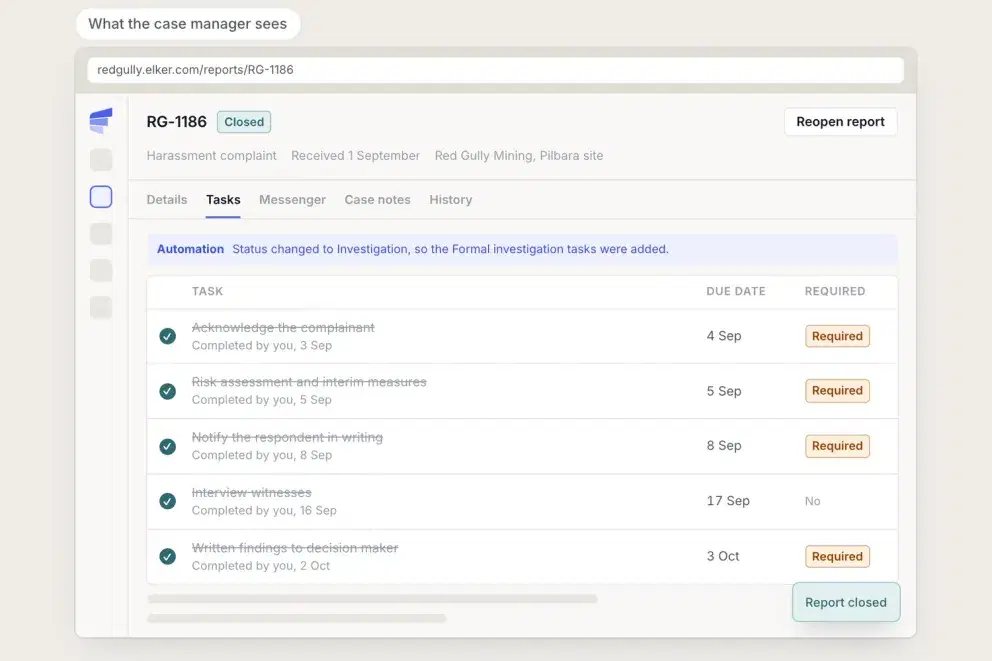
Tasks with due dates
Give each task an owner and a due date. One list shows what is overdue or due today across every case.
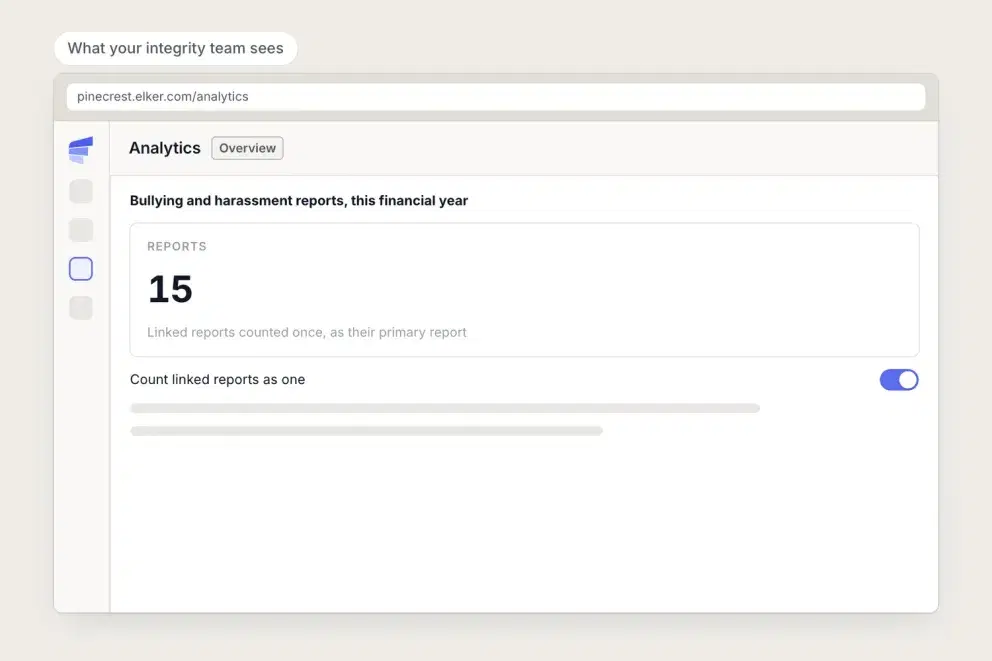
Linked reports
Connect complaints and misconduct reports about the same people or events, so patterns show up across cases instead of sitting in separate files.
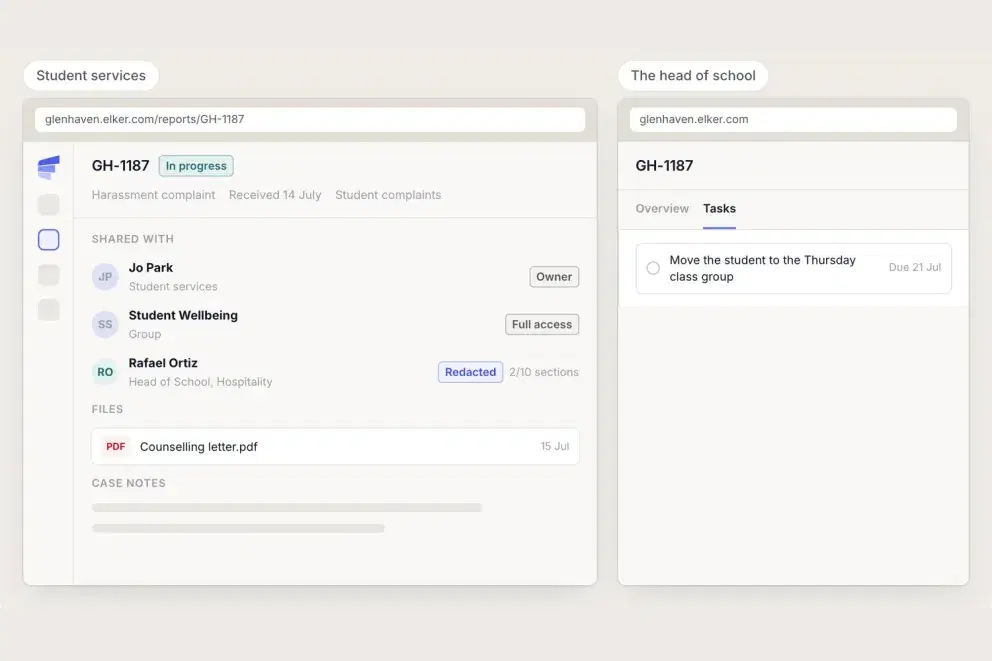
Only the people on the case
Restrict each case to the people handling it. Role-based access and a full audit trail record who did what.
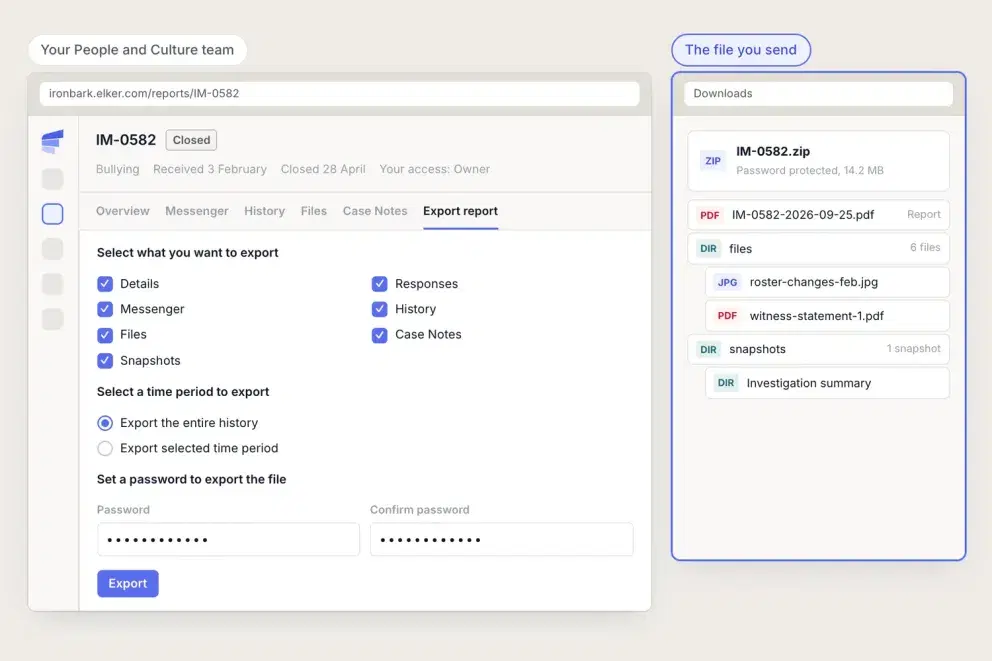
Ready for the board pack
Export case data to PDF, CSV or Excel for a board pack, an audit or an external advisor.
Frequently asked questions
See Elker in action

Safeguard your data with the highest security standards
- ISO 27001 certified
- SOC2 attested
- AES-256 encryption for data in transit and at rest
- Regional data hosting to meet local data privacy requirements
- Third-party security audits and penetration testing


See how Elker can help with compliance and build a culture of accountability and trust in your organisation.